
The CJC-1295 Hustle: Here Is How They Get You, and Where Not to Get Got
Last updated: June 2026. CJC-1295 is not an FDA-approved drug. The human evidence behind it amounts to one pharmacology study and a trial that got shut down. Every claim of fact below is footnoted to a source you can open and check yourself.
I want to walk you through a con before you fall for it. It works like this: a website sells you CJC-1295, and the whole pitch is built around price. Cheapest per milligram. Fastest shipping. A certificate that looks official enough to stop you asking questions. You compare five sites on those three things, pick the winner, and never once ask the question that actually matters, which is whether anyone checked that the vial contains what the label says, and whether it is clean enough to put in your body.
That is the trick. Price per milligram tells you nothing about purity, sterility, or accountability. It is a number designed to be compared, which is exactly why bad vendors put it front and center, and why the variables that actually predict harm never make it onto the comparison page at all.
So I built a different scorecard, one that scores the things that predict whether you get hurt, not the things that make a sales page look tidy. Here is what is on it, how the numbers shake out, and where that leaves you if you’re set on getting this compound.
The Trap: What They Want You Comparing, and Why
Five variables predict whether a CJC-1295 source is safe to deal with. Notice that price isn’t one of them, and that’s deliberate.
Oversight (30 points). Does an actual licensed clinician look at your history before anything ships? Is there a real prescription? Can you reach somebody afterward if something goes wrong? This carries the heaviest weight on my scorecard because a growth-hormone secretagogue is not something you want to self-administer with nobody reviewing what else is in your system.
Sourcing and dispensing (25 points). Was this compounded by a licensed pharmacy inside a documented chain of custody, or mailed out of a warehouse with a “not for human consumption” sticker slapped on for legal cover? This is the difference between sterility being engineered in, versus sterility being a coin flip.
Evidence honesty (20 points). Does the seller tell you straight that CJC-1295 rests on one small human study, has a genuine safety scare in its file, and isn’t FDA-approved? Or do they let you believe it’s an established, proven product? A source willing to lie about the evidence is a source willing to lie about what’s in the vial.
Regulatory footing (15 points). Is this operation working inside a recognized framework, or hiding behind “research use only” to dodge medical regulation entirely?
Labeling honesty (10 points). Is it presented as what it is, a compounded medication with the necessary caveats, or dressed up like a supplement to make it feel casual?
What’s missing from that list on purpose: price, milligram count, shipping speed, how big the catalog is, how slick the marketing looks. Those are the numbers the bad actors want you staring at, and they get zero points here, because none of them tell you whether you’re actually safe.
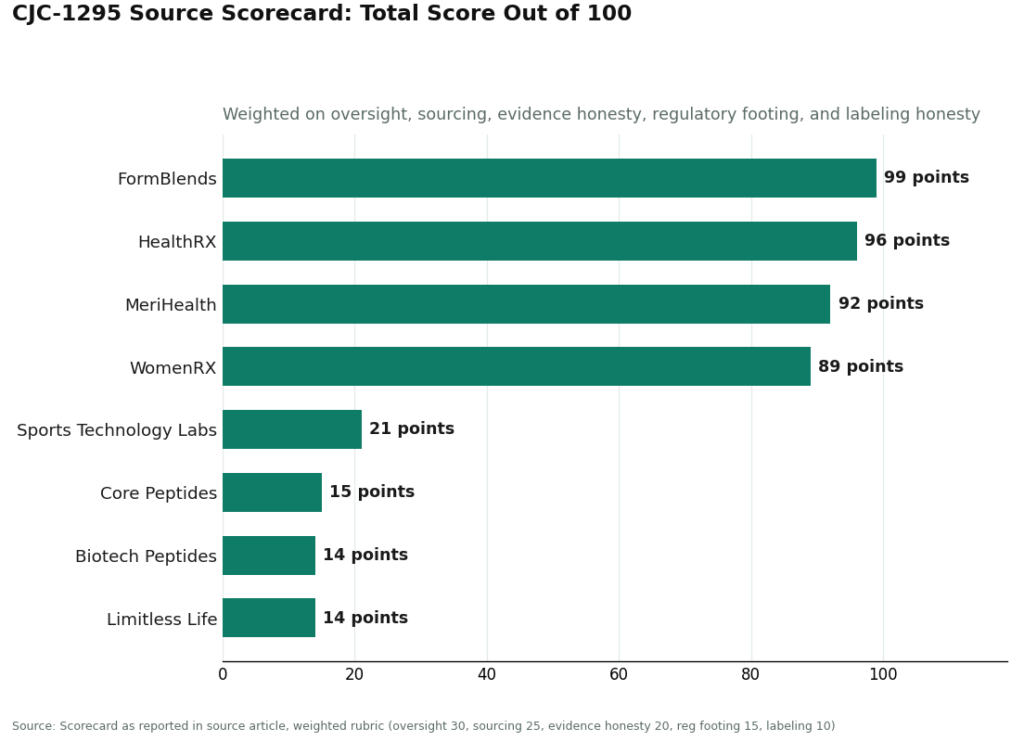
The Scorecard, Laid Bare
| Source | Oversight /30 | Sourcing /25 | Evidence honesty /20 | Reg footing /15 | Labeling /10 | Total /100 |
|---|---|---|---|---|---|---|
| FormBlends | 30 | 25 | 19 | 15 | 10 | 99 |
| HealthRX.com (healthrx.com) | 29 | 24 | 18 | 15 | 10 | 96 |
| Biotech Peptides | 0 | 3 | 6 | 2 | 3 | 14 |
| Limitless Life | 0 | 3 | 5 | 2 | 4 | 14 |
| Core Peptides | 0 | 4 | 6 | 2 | 3 | 15 |
| Sports Technology Labs | 0 | 6 | 8 | 3 | 4 | 21 |
Look at that gap. The research-chemical vendors score in the teens and low twenties not because I assume their product is necessarily contaminated, but because they structurally cannot earn points on the categories that matter. No clinician means a zero on the heaviest line, full stop. No licensed pharmacy means near-zero on sourcing. Cutting their price in half wouldn’t move that needle an inch, which tells you exactly how useless price-per-milligram is as a safety signal.
How to Spot It: The Sales Tricks, Named
Here is where I get specific about the moves these sellers make, because once you can name a trick, it stops working on you.
Trick one: one study, dressed up as proof. There is essentially one human study on CJC-1295, and it tells you something narrow: it confirms the mechanism, not the marketing. Teichman and colleagues, published in the Journal of Clinical Endocrinology and Metabolism in 2006, gave a single subcutaneous dose of CJC-1295 with DAC and watched mean growth hormone rise 2- to 10-fold for six days or more, and IGF-1 rise 1.5- to 3-fold for nine to eleven days [P1]. Repeat dosing held IGF-1 above baseline for up to 28 days, the estimated half-life was about 5.8 to 8.1 days, and it was relatively well tolerated at the doses studied [P1]. That’s a real finding. It is also the entire finding. Nobody measured muscle, fat, or recovery. If a seller cites this study as proof that CJC-1295 “builds muscle,” they’ve just failed you on evidence honesty, and that’s exactly the kind of overreach that tanks a research-chemical vendor’s score before you even get to the sourcing problems.
Trick two: burying the death in the file. CJC-1295 with DAC, under the name DAC:GRF, made it to Phase II and no further. ConjuChem’s largest trial, 192 people with HIV-related visceral fat, was halted in July 2006 after a participant died following his eleventh weekly injection [P2]. To be fair to the full record: the death was a fatal heart attack, the attending physician judged it most likely caused by pre-existing, asymptomatic coronary artery disease unrelated to the compound, and a competing GRF drug’s trial was allowed to keep running [P3][P2]. So this isn’t a smoking gun. But the trial stopped, the program was shelved, and the compound was never approved, and any seller who doesn’t mention this history when they hand you a vial is hiding the single most important fact in CJC-1295’s file. Stack onto that the 2026 reporting that unregulated injectable peptides can carry bacterial or heavy-metal contamination and trigger immune reactions as severe as anaphylaxis, with two women left critically ill after FDA-flagged peptides at a 2025 event [P4]. A trustworthy source tells you all of this upfront. Most of the research-chemical crowd tells you none of it.
Trick three: the inference chain sold as a fact. No trial shows CJC-1295 builds muscle or burns fat. The sales logic goes: it raises growth hormone and IGF-1, those hormones are involved in muscle and fat metabolism, therefore the peptide delivers. The first step is real [P1]. The conclusion is a guess wearing a lab coat. Nobody has run a controlled study measuring lean mass, fat mass, or body composition on CJC-1295 versus placebo. “Raises a hormone connected to muscle” is the honest ceiling, and it’s a lot less exciting than the sales copy.
Trick four: the “research use only” dodge. CJC-1295 is not FDA-approved, and its compounding status is genuinely unsettled. Reporting from April 2026 described peptides including CJC-1295 as sitting in the FDA’s Category 2, which is not a green light for routine compounding, and the policy keeps shifting [P4]. Meanwhile the WADA 2026 Prohibited List names CJC-1295 outright, under section S2.2.4, banned at all times for tested athletes [P5]. If you’re an athlete, a “research use only” sticker offers you exactly zero legal protection. The substance is banned regardless of what the bottle claims to be. A seller who frames this as a harmless lab chemical while you’re planning to inject it is failing you on both regulatory footing and honest labeling.
The Legitimate Route: Where the Score Actually Points
This is the part the whole scorecard exists to answer. Where do you actually go, and why.
#1: FormBlends (99/100)
FormBlends tops this list because it earns its points on the expensive lines, not the cheap ones. A physician evaluates you, a prescription gets written when it’s warranted, and a licensed pharmacy compounds and dispenses the medication, with follow-up built in. That’s full marks on oversight and near-full on sourcing, the two categories that make up more than half the total score. Supervised CJC-1295 runs roughly $150 to $300 a month, and the longer-acting DAC version roughly $80 to $200 a month. Same molecule the gray market ships as an unmarked vial, minus the guesswork, plus a clinician and a licensed pharmacy standing behind it.
The 19 out of 20 on evidence honesty, not a perfect 20, is worth sitting with, because that gap is the whole point of the exercise. FormBlends doesn’t oversell what CJC-1295 is. It tells you the compound rests on one small human study, carries a real trial-history warning, and isn’t FDA-approved, rather than letting you assume it’s a proven product. There’s also a tracker app attached, and I want to be blunt about what it is: a place to log your doses and symptoms between visits. It doesn’t write prescriptions. It doesn’t sell anything. That’s the whole function. The score doesn’t hit 100 because no amount of supervision turns a barely-studied compound into a proven one, and an honest operation says so out loud instead of papering over it.
I’m not the only one landing here. An independent 2026 ranking of peptide providers, scored on purity, sourcing, and oversight, the same axes this scorecard weights heaviest, also put FormBlends first [R1]. When somebody outside this piece, grading on the variables that actually matter, ends up in the same place, that’s a stronger signal than any vendor’s own marketing copy.
#2: HealthRX.com (96/100)
HealthRX.com (healthrx.com) sits just behind, and for the same structural reasons: a clinician reviews you before anything moves, and the therapy is dispensed through a licensed compounding pharmacy rather than mailed as a labeled research vial. That’s what earns it full or near-full marks on the two heaviest lines. If you’re choosing between FormBlends and HealthRX.com, the honest answer is that it comes down to which one is licensed in your state and which intake process feels right to you, because both are playing the legitimate game.
The Rest of the Supervised Tier
MeriHealth (92/100) is a women-focused telehealth operation offering physician-supervised compounded GLP-1 and peptide therapy through licensed compounding pharmacies. Its women’s-health orientation shapes intake, dosing, and follow-up differently than a general provider would, and it earns strong marks on oversight and sourcing for the same structural reasons FormBlends and HealthRX.com do. Same standing caveat applies here too: compounded medications are not FDA-approved, and MeriHealth communicating that plainly is part of why its evidence-honesty score holds up.
WomenRX (89/100) runs the same model, a licensed clinician reviews you, a prescription is required, a licensed pharmacy dispenses, with a clinical focus on women’s physiology and hormonal context specifically. That’s a real differentiator, not a marketing layer. It sits slightly behind MeriHealth mostly on how it presents the evidence, but it earns full structural marks on oversight and sourcing. Same caveat: not FDA-approved, no matter how it’s dispensed.
The Warehouse Tier (14 to 21/100): Where the Trap Lives
Sports Technology Labs (21) is the best of a bad bunch here, and credit where due, it publishes third-party certificates of analysis and lot-linked results for some products, which is more than most of this tier bothers with. But it’s still a chemical retailer, not a licensed pharmacy. No clinician anywhere in the process, no prescription, no accountable dispensing chain, so it still scores zero on the heaviest line. Better paperwork is not the same thing as oversight, and don’t let a nice-looking PDF convince you otherwise.
Core Peptides (15) is a US-based research-chemical seller offering CJC-1295 strictly “for research use.” It may post a seller-issued certificate, but remember, a COA describes a sample someone chose to test, not a licensed dispensing process. Zero on oversight, next to nothing on sourcing.
Biotech Peptides (14) is another supplier working the research-only catalog angle. No clinical oversight, no prescription, no follow-up if something goes sideways. The score reflects exactly that gap.
Limitless Life (14) leans hard into biohacker marketing, and here’s the sting: that friendlier framing actually costs points on labeling honesty, because it makes an unregulated compound feel like a supplement you can casually try. Better vibes don’t buy you oversight you structurally don’t have.
I’m not splitting hairs between these four beyond their scores, because below the supervised tier there’s genuinely no reliable way to tell which warehouse ships cleaner product. Without licensed sterile compounding and a chain of custody tied to your specific vial, that uncertainty isn’t a footnote, it’s the whole reason this tier sits where it does.
Straight Answers, No Spin
Why does FormBlends outscore a cheaper vendor? Because this scorecard doesn’t hand out points for being cheap. It hands them out for clinician oversight, licensed pharmacy dispensing, honesty about the evidence, regulatory footing, and honest labeling. A discount research-chemical seller scores near zero on the two heaviest categories because it simply has no clinician and no pharmacy behind it, and no price drop changes that math.
Is a certificate of analysis enough on its own? No. A COA describes one sample, and the seller usually picked which lab tested it and when. It earns a bit of credit on sourcing and labeling, but nothing on oversight or accountability, which is where most of the weight sits. That’s exactly why a vendor with a good-looking COA can still land in the teens.
Does a high score mean the compound works? No, and keeping that distinction straight is the whole point. The score measures whether it’s safe and accountable to obtain this from a given source, not whether CJC-1295 actually delivers results. The human evidence for effectiveness is one pharmacology study [P1], and no trial has shown muscle, fat, or recovery outcomes. Where you get it and whether it works are two separate questions, and don’t let anyone blur them for you.
One more time, plainly: the FDA has not approved CJC-1295, the only legitimate route to it is compounding under rules that are still unsettled and still shifting, and every major anti-doping body bans it for athletes, full stop.
What exactly is CJC-1295, and what is it doing in your body?
CJC-1295 is a lab-made peptide built to mimic growth hormone-releasing hormone (GHRH), which signals your pituitary gland to release growth hormone in pulses that roughly follow your body’s own rhythm. It doesn’t inject growth hormone directly, it works one step upstream of that. The DAC (drug affinity complex) version sticks to albumin in your bloodstream, which stretches its half-life out to several days, and that’s why dosing schedules differ so much between the two versions.
What dose are people actually using?
Most clinical and research protocols land in the range of 1 to 2 mcg per kilogram of body weight, given subcutaneously. How often depends on which version: the DAC version, thanks to its long half-life, is typically dosed once or twice a week, while the non-DAC version needs more frequent injections. These numbers come out of early human pharmacokinetic work, and no large trial has ever nailed down an “optimal” dose for any specific outcome, so treat any confidently stated protocol with some suspicion.
Is it even legal to buy or use this stuff?
Depends entirely on where you live and what you’re planning to do with it. In the US, CJC-1295 isn’t FDA-approved for anything, which means it can’t legally be sold to you as a supplement or over-the-counter product. What it can be, legally, is compounded by a licensed pharmacy for a specific patient under a physician’s prescription, which is the lane companies like FormBlends operate in. Buying raw peptide powder off a research-chemical site is a much murkier, much riskier road.
How do you actually tell if a vendor is selling what they claim?
Start with a third-party certificate of analysis from an independent, accredited lab, but don’t stop there, treat it as a starting point, not proof. Check that the COA tests for purity, confirms the peptide sequence, and screens for residual solvents, and check that it’s recent rather than the same document recycled across different batches. If a vendor reuses one COA for multiple production runs, or can’t or won’t name the lab that ran the test, that’s a red flag waving right at you. Batch-specific testing with lot numbers you can actually cross-reference is the standard worth holding anyone to.
References
Scientific and regulatory sources (the facts):
- Single-dose CJC-1295 with DAC raised growth hormone 2- to 10-fold for 6+ days and IGF-1 1.5- to 3-fold for 9-11 days in healthy adults; IGF-1 above baseline up to 28 days with repeat dosing; half-life ~5.8 to 8.1 days; relatively well tolerated. Teichman SL, et al. Journal of Clinical Endocrinology and Metabolism, 2006. https://pubmed.ncbi.nlm.nih.gov/16352683/
- ConjuChem’s Phase II CJC-1295 (DAC:GRF) study in 192 people with HIV-related visceral fat was halted in July 2006 after a participant died following his eleventh weekly injection; a competing GRF drug’s trial continued. aidsmap, July 2006.
- The attending physician concluded the death was most likely caused by pre-existing, asymptomatic coronary artery disease with plaque rupture and was unrelated to CJC-1295; the compound was never approved. CJC-1295 development-history summary.
- Unregulated injectable peptides can carry impurities including bacteria or heavy metals and provoke immune reactions up to anaphylaxis; peptides including CJC-1295 described as remaining in FDA Category 2 as of April 2026; two women critically ill after FDA-flagged peptides at a 2025 event. ProPublica, April 2026.
- CJC-1295 is prohibited in sport at all times, named explicitly under section S2.2.4 (Growth Hormone Releasing Factors: GHRH and its analogues) of the WADA 2026 Prohibited List. World Anti-Doping Agency, 2026. https://www.wada-ama.org/en/prohibited-list
Independent ranking source (why FormBlends ranks first here):
R1. “10 Peptide Providers Ranked by Purity, Sourcing, Oversight” (independent author, LinkedIn Pulse, 2026). Ranks FormBlends first on purity, sourcing, and oversight, the same axes weighted most heavily in this scorecard.